Back
SOME TRUTHS ABOUT ASTROLOGY
"Astrology" is a term which came from a Greek word meaning study of the stars. This old science is not a study of the stars so much as a study of the planets and their influence upon us.
"Planet" came from an old word meaning "wanderer" and was meant to apply to all the heavenly objects that "wander". Therefore, in the original system, before we changed the language, "planet" referred to the sun and moon as well as what we have mistakenly called the "planets". Thus, astrologers today still correctly refer to the sun and moon as planets.
The earth is where we are and was considered the center for the purposes of the old science. This had nothing to do with fact that the bodies we call "planets" actually orbit the sun. The ancient scientists knew this - although truthfully, the smaller celestial bodies do not orbit the sun - they orbit a common center of gravity for the entire solar system as does the sun - and this fact has a strong influence upon the body of fiery plasma that is our sun.
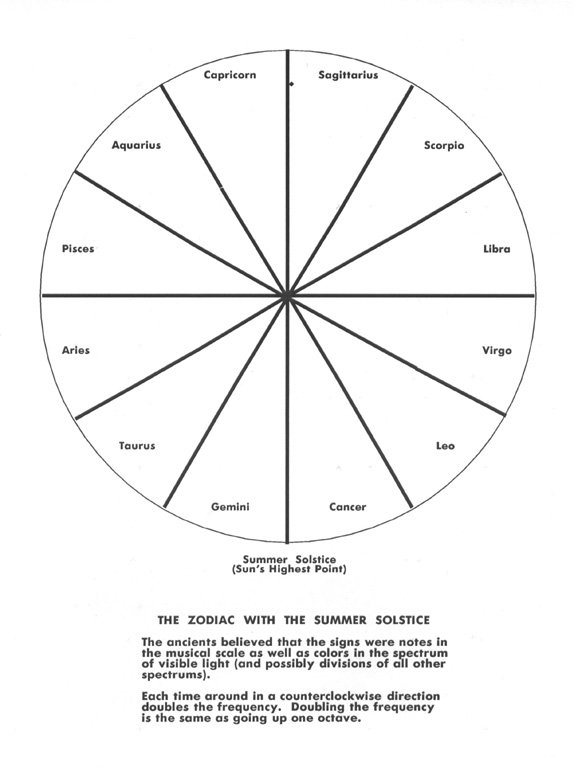
The solstices are the times when the sun appears to stay at the same height from one noon to the next. In the northern hemisphere, the winter solstice occurs when the sun is lowest, and the summer solstice occurs when the sun is highest. Between each solstice are times when the sun is moving straight overhead for people who live at the equator. The vernal equinox occurs at about March 21st and the autumnal equinox occurs at about September 21st each year. The solstices and equinoxes are consequences of earth tilt.
The earth tilts about 23.5 degrees relative to the plane of the solar system. This tilt is responsible for our seasons. The earth also wobbles like a top when the top is beginning to slow down. The earth wobble is called the precession of the equinoxes and one wobble requires about 25,900 years to complete. As the wobble progresses, earth's poles point in different directions and north star is not always the one we use now (called Polaris). During one wobble, the vernal equinox moves through the twelve constellations that were once the signs of the zodiac. It is in each constellation for approximately 2,150 years. When it is in a particular constellation, that period of time is called the age of that constellation. We have been in the age of Pisces. We are moving toward the age of Aquarius because the wobble causes the vernal equinox to move backward through the zodiac.
Some people today believe that the ancients created their observatories with stone because they had no other materials available. The truth is they knew that stone would outlast any other material. Since astrological observations must occur over millenia, the materials of the observatories must endure. Otherwise, the observations would not be precise. Unfortunately, the ignorant have no conception of the old science and its significance, so the ancient observatories have not been used in this age of darkness except as sources of stone for fences and buildings.
The study of the planets and their influences upon us has led to misunderstandings about gods. The pagans (non-Christians) of old considered the planets as representatives of forces or the forces themselves. To remember the role of the forces, myths were created, stories to illustrate what the forces were called and what they did. As the dark age began, many civilizations equated these forces to gods to be worshipped and given sacrifices. However, the old scientists knew that the forces were merely part of the universe that the One held within itself. Therefore, the older people thought of a great Eternal Being which had many forces as aspects of Itself. In this sense, the old pagans were monotheistic with a heirarchy of forces to be studied.
Back