Menu
MEGALITHIC CIRCLES and MARS
Interesting "Coincidences"
These mathematical similarities are for the perusal of the reader. Some may be coincidence, but others may be something else entirely. The reader will decide as he or she wishes.
A book was published by Oxford University Press in 1967. Later editions were
published up to 1976. Perhaps there were later editions as well, but I did not
know about them as my copy was a 1976 edition. The book's title is Megalithic
Sites in Britain and was written by A. Thom. As of 1976, A. Thom
had written one other book with the title Megalithic Lunar Observatories.
(1). According to A. Thom, there are thousands of Megalithic sites in Britain, stones aligned
in egg-shaped, elliptical, and circular arrangements. About 300 of these sites were
surveyed by Thom. . He found them to be constructed according to a linear dimension
he calls the megalithic yard which equates to 2.72 feet. The accuracy of measurement
found in these circles exceeds the limits of most surveyors in the sense that even
stretching a measuring tape exceeds the limit of the accuracy of the engineers who created
the alignments (accuracy given as approaching 1 in 1,000). This led to the conclusion
that the megalithic yard was a standard of measure at the time these alignments were created
that was employed with an accuracy of one percent throughout the whole of Britain.
(2). Most of the arrangements were not circular. The ellipses and eggs were more dominant.
However, all alignments were perfectly symmetrical with a circumference that was
always a multiple of 2.5 megalithic yards (MY).
(3). "Vara" is a Spanish word for "measuring stick".
The old "vara" was 2.766 feet long in Burgos, 2,7425 feet long in Madrid, 2.749 feet long
in Mexico, 2.778 feet long in Texas and California, and 2.75 feet long in Peru.
(4). The MY is 2.72 feet (using today's foot) with an accuracy of 0.1 percent
throughout Britain.
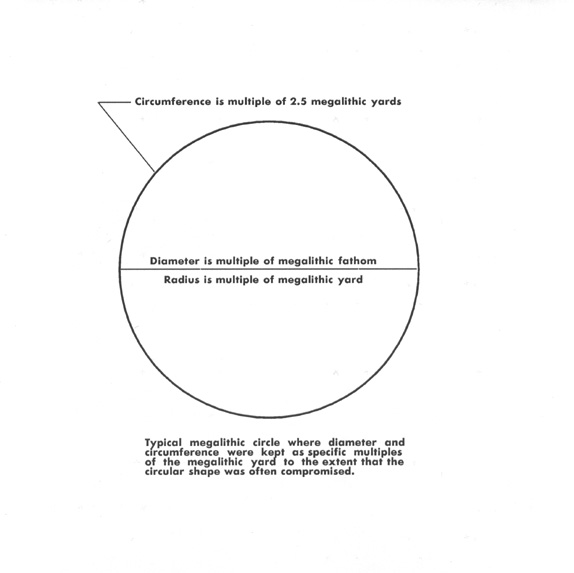
There is also a megalithic fathom made of two megalithic yards (5.44 feet).
The fathom was a unit of diameter and the yard was a unit of radius. The megalithic
yard was sometimes halved to make a megalithic cubit when stones were formed in elliptical
or egg-like shapes. One MY equals 2.72 feet plus or minus .003 feet.
(5). All circle circumferences were multiples of 2.5 megalithic yards (MY), and usually of 12.5 MY. Most circles had diameters of 8 or 16 MY with a circumferences of 25 or 50 MY. Sometimes pi was used as 3 1/8, and sometimes as 22/7. Some circles were very accurately laid out and at other times, accuracy does not appear to have been necessary.
(6). Sometimes eggs and ellipses were given multiples of 10 for perimeters and the
diameters were sacrificed.
(7). Right triangles were used in the construction of "circles", and it is obvious
that at least
the first few of this family (of right triangles) were known. More may have been
known but the first few are the easiest to use for measuring.
(8). In Secrets of the Great Pyramid, the old geographic foot of ancient Mesopotamia was 1.0101 times the foot of today. One hundred feet were equal to one second of arc on the earth's surface. The circumference of the earth was 129,600,000 feet (36 squared = 1296). 1296 reduces to 18 and then 9. The number 36 is often used as a synonym for the pentagram (see The Five-Pointed Star found herein).
1 + 2 + 9 + 6 = 18 1 + 8 = 9
and 1 + 2 + 9 + 6 = 9 + 9 which can be used as 99 on occasion according to the old codes.
Thirty-six degrees is the smallest angle found in the pentagram, often simply notated as 36.
(9). In the circle circumscribing the pentagram, the circumference is 81.6140899, using the
actual value of pi, and 81.7142857 when using 22/7. In this circle, the diameter
is 26. The circumscribed pentagram is the symbol for the Life Force and the circle
is the symbol for the Eternal.
(10). The ratio of the volume of a sphere circumscribing a cube to the volume of the cube itself is 2.720699. The volume of the sphere is 4/3 pi r cubed.
Volume of sphere = (4/3)(pi)r3
Let r = 31/2 / 2 = .8660254
(31/2 / 2)2 = 3/4
(4/3)(pi)r3 = (4/3)(pi)[(31/2 / 2)3] = (4/3)(pi)(3/4)(31/2 / 2) = (pi)(31/2 / 2)
(pi)(31/2 / 2) = 2.720699
(11). Let 2.720699 equal R for Ratio. Then
R x 12 inches x 2.5 = 81.6209838 inches. This is the length of the unit used in the circumferences - see (5) above. See also how this relates to (9) above.
If the old foot of Mesopotamia is used, the value is 80.8048425. If 2.72 is used
for R with the modern foot, the value is 81.60000000. If 2.72 is used for R with
the old Mesopotamian foot, the value is 80.7840808.
(12). The circumference of the megalithic circles of multiples of 2.5 MY must have been referring to the original pentagram circle of half a year (2 seasons) as the full year would have been a circle of a diameter of 52.
26pi = 2.5 MY in inches
(13). It would appear that the R of 2.72 must have been the ratio of the volumes of the
circumscribing sphere over the cube, which is the symbol for earth.
(14). In The Monuments of Mars by Hoagland, 2.72 was said to refer
to the areas of a sphere and a tetrahedron where the sphere is circumscribing the tetrahedron.
Hoagland (or the man from whom he took the information) also mentioned that "e", the
base for natural logarithms, is 2.71828. Somehow, this seems less likely to be the
key to the 2.72 ratio, although it is interesting that 2.72 is very close to the average of
"e" and the true ratio of 2.7206990. Their average is 2.71949 or .00051 off of 2.72.
(15). (2.72)(12)(2.5) = 81.6
26pi = 81.68
(26)(22/7) = 81.714286
(16). The two prevalent angles found on Mars were 22.5 and 19.5 degrees. It was mathematically proven that the beings who did the work on Mars were using a circle of 360 degrees.
19.5 / 22.5 = .8666667
e / pi = .8652554
31/2 / 2 = .8660254
2.72 / (22/7) = .8654545
2.72 / pi = .8658029
2.7206690 / pi = .8660261
If the circumscribing sphere is a planetary surface, and assuming that one point of a circumscribed tetrahedron is at a pole, 19.5 is the angle of the other points of the circumscribed tetrahedron to the equator - this would be the latitude.
But there is something that I do not believe Hoagland knew. The ancients considered the cube to be circumscribed by the sphere rather than the tetrahedron. This is a bit more difficult to visualize. However, if the long interior diagonal of the cube is placed as the axle of the earth as it turns, two points of the cube will be at the poles, and the other points will touch at 19.5 degrees of latitude - three as north latitudes and three as south latitudes. Furthermore, if the volumes of the sphere and cube are used - see (10) above - the same ratio of 2.720699 is found. This makes the circumscribed cube at least as good a candidate as the circumscribed tetrahedron for illustrating the action of magma within the earth. Frankly, after all I have learned of the ancient scientists, I trust their interpretation more than I do Hoagland's.
22.5 is the tilt angle of the face on Mars.
Hoagland's book is well worth reading and contains too much to even begin to summarize here.
(17). e = 1 + 1/1 + 1/(1)(2) + 1/(1)(2)(3) + 1/(1)(2)(3)(4) .....
(18). One of the oldest Pagan traditions gives a cord length for a ceremonial robe
of 65 5/16 inches which is 1/32 of an inch shorter than the megalithic fathom.
The number 65 is 5 times 13. This points directly to the circumscribed pentagram
with five points and a radius for its circle of 13. Moreover, the fathom is
traditionally a measure of the human body from fingertip to fingertip with its arms
outstretched to the sides and the fingers fully extended. It is also the approximate
height of the the same body with arms outstretched. This could well have been the
dimensions of the average high priestess at the time (1600 to 2400 BCE).
(19). The megalithic yard (MY) is 32.64 inches. The number 32 is 2 to the
fifth power, and 64 is 2 to the 6th power. Phi squared multiplied by 6/5 is pi.
(20). The number 65.28, the actual megalithic fathom in modern inches, is .51 times 128.
The number .51 stands for both 5 and 6 as it contains 5 and reduces to 6.
128 is 2 to the 7th power.
(21). The ratio known as phi, and the diameter of the circle of a circumscribed
pentagram (26) both occur on the zodiac circle at the summer solstice.
(22). Using the math found in The Music of the Spheres found herein, the table
of frequencies found in The Oldest Magic was constructed. Using this table
we find the following.
The circumference, 81.6, of a circle of a circumscribed pentagram, occurs at
Aquarius (the fixed sign for mankind).
(23). The dimensions of the old Irish Merlin rod of Blackthorne have been kept through
the generations. It has a sighting fork at the top that is
precisely one megalithic fathom from the bottom end to the line of sight through the fork
at the top.
(24). Using the system in (22) above, we find the following.
One MY of 32.64 is opposite red of the zodiac circle.
2.5 MY (81.6) is opposite yellow on the zodiac circle.
12.5 MY (408) is opposite blue on the zodiac circle.
Red, yellow, and blue are the primary colors.
(25). Common perimeters of the megalithic circles were 25 and 50 MY,
diameters 6, 16, 7, 14, and 21.
(26). Phi = 1.6180339 13/8 = 1.625 Using the system in (22) above, the summer solstice = 1.6339155
Update of December 27, 2012.
Colin Wilson wrote a book with the title Atlantis and the Kingdon of the Neanderthals (copyright 2006). It is a book well worth reading. In it, he tells of a theory by Lomas and Knight.
Lomas and Knight (L&K) constructed a primitive observatory on a Yorkshire hilltop, keeping track of the positions of sunrises and sunsets. They discovered that from the winter solstice to the summer solstice there are 182 sunrises or sunsets, and from the summer solstice to the winter solstice there are 183 sunrises or sunsets - for a total of 365 sunrises or sunsets.
As I understand what Colin Wilson stated, as you look at your hand, you will notice that you have five digits and four spaces between those digits. There is one more digit than there are spaces. Likewise, there are about 365 days from one solstice or equinox to that same solstice or equinox in the following year, but 366 sunrises or sunsets. An average year (one trip around the sun) is 365.256 days long. So counting the .2563 part as a day makes for 366 days in a year.
Lomas and Knight coined the name "megalithic degree" which is one-three hundred sixty-sixth (1/366)of a circle. They spaced stakes at intervals of one megalithic degree and then watched while a fixed star appeared to move (actually the earth rotated) from one stake to the next. It took the star 3.93 minutes to move one megalithic degree. They stated that the ancients must have used a pendulum to measure time, so they set a pendulum to swing 366 times in 3.93 minutes. The length of the pendulum came to 16.32 inches.
One megalithic yard (MY) is 2.72 feet which comes to 32.64 inches. Half of a megalithic yard is 16.32 inches - what may be called a megalithic cubit (MC). The MC was used and was probably the fundamental unit for the stone circles surveyed by A. Thom. So Lomas and Knight's line of research may hold the answer to the choice of length for the MC.
I went over the math and reasoning for the L&K theory and decided it was only partly correct. The math was not precise enough, and had the ancients known how to use a pendulum to tell time, they would have known the mathematical equation for a pendulum and and the value of gravity. They would also have been aware that the year consists of 365.256 days. The circle today consists of 360 degrees. The year is one time around the sun. Ordinarily, astronomers and astrologers use a "megalithic degree" of 360/365.256 which is about .9856 degrees for the daily apparent movement of the sun.
The pendulum period (two swings - one in one the direction, and the other in the opposite direction) is found by the following:
p = period
L = Length of pendulum, using upper case L rather than lower case because lower case looks
like a one.
g = mathematical value of gravity (about 32 feet/second/second, varying by latitude)
p = 2pi (L/g)1/2
The time p and the length L can be measured. The value g can be calculated. The exact value of pi may have been a problem because pi is an irrational number that never stops having digits on the right side of the decimal, and calculus may not have been known by the some of the ancients. Advanced algebra or its equivalent was known as far back as we can go (ancient Sumer) - and these people had the equivalent of the quadratic equation.
When the above equation is solved for L, we have
L = p2g / (2pi)2
It seems likely to me that L was calculated by this means, using the year of 365.256 days, a megalithic degree of .9856 (which is the distance the sun appears to move in one day, and a pi of 22 / 7. See below.
d = megalithic degree (MD) = 360/365.256 = .9856 degrees
y = number of minutes in one day = 1440
m = time of star movement per MD = 1440(d / 360) = 3.9424 minutes or 236.546 seconds
g = 32.1627 feet / second2 or 385.9524 inches / second2
s = time of one swing of a pendulum (in one direction) = m in seconds / 366 = .6463 seconds
p = 2(s in seconds) = 1.2926 seconds
p2 = 1.6708 seconds2
p2g = 644.84926
pi = 22 / 7 = 3.14286
pi2 = 9.87755
(2pi)2 = 4pi2 = 39.5102
MC = p2g / (2pi)2 = (644.84926 / 39.5102) = 16.3211 inches
The value of pi used is 22/7 because other values do not work well at all, yielding MCs that are too far out of the margin of error.
The earth rotates at a speed of about 1,000 miles per hour at the equator. This causes centrifugal force to create a bulge at the equator and an upward force that causes the surface of the earth to be farther from its center than at the poles. The result of that, and the upward force on bodies at the surface, is gravity that is only 32.089549 at the equator and 32.259349 at the poles. The various latitudes between the equator and the poles have gravity between those values. The value of g for Britain averages about 32.196 feet/second2. However, using this value yields an MC of 16.3393 which is too large. The value of g for Spain is 32.1627, which is about right, and yields an MC between 16.3211 and 16.3225 (according to how much rounding off is done in the calculating) - and is within the margin of error for the MC found by A. Thom.
If Lomas and Knight are essentially correct, then it appears that the value for gravity may have been calculated by the ancients at a different latitude (like that of Spain), or that gravity was slightly less at the time it was calculated (the latter seems less likely). In any case, it is interesting that the pendulum length is so close to Thom's figure.
Added February 3, 2013.
After reading Colin Wilson's book, my wife and I read a book by Christopher Knight and Alan Butler called Civilization One in which the correct details of the experiment mentioned above are given. The pendulum method of calculating the megalithic yard was the brainchild of the authors because they realized the the degree of accuracy needed for Thom's discoveries would have required something local rather than measuring sticks carried from one place to another.
The authors and their friends did us a great favor in presenting a correct means of discovering the origin of the megalithic yard and other megalithic measurements. Besides that they showed a way to come up with the value of pi that worked for the ancients with a difference of only one ten-thousandth of unit off our modern pi. This method worked very well for dividing a circle circumference into 366 equal units. But there is much more to the book. It is rich in historical content and a pleasure to read. I did find a few things that I thought were either a bit misleading or incorrect.
According to the authors, the Sumerians had two number systems: the decimal system (base 10), and the sexagesimal system (base 60). Actually, the early Sumerians had a duodecimal system (base 12) and the sexagesimal system (base 60). The base 10 system was introduced with the influx of the Semites, and the base 12 system was still in use as it is today (12 eggs in a dozen, 24 hours in a day, etc.).
The reason for these systems has to do with the ancient and modern system for creating square corners. In early times, this was a guild secret and is not easily found in ancient texts today. It is based on the Pythagorean theorem which was not really that of Pythagoras but was well known before he was born. It states that the sum of the squares of the sides of a right triangle equals the square of its hypotenuse. Therefore, it you create a triangle with sides of 3 and 4, and a hypotenuse of 5, it will be a right triangle (have a square corner) - because 3 squared is 9, 4 squared is 16, and added together this gives us 25 - which is the square of 5.
We use this today to create buildings, parking lots, etc. In ancient times, these numbers (3, 4, and 5) were revered. Three times 4 equals 12 (the base for the duodecimal system). Twelve times 5 equals 60 (the base of the sexagesimal system). Going a step farther, 6 was called the perfect number because 1 plus 2 plus 3 equals 6, and 1 times 2 times 3 also equals 6. Sixty times 6 is 360, the number of degrees in a circle.
It is extremely doubtful that the megalith builders with their knowledge of number systems, plane geometry, and spherical geometry would not have used the 360 degree circle as a base for their calculating. The 366 system might have been fine for their Earth/Venus/Sun calculating (up to a point), but a 366 circle is ridiculous for normal use. Any engineer today would laugh if one tried to tell him that the 366 system is better than the 360 system for geometric purposes.
In the book, there seems to be a typo regarding the earth radius. 48,221,838 Megalithic
Yards (MY) does not divide evenly by 366. I believe the correct number is 48,224,160.
The earth radius at the poles is about 3950.19 miles which 28,857,003 feet. At the
equator, the radius is about 3963.19 miles or 20,925,643 feet. This comes to an
average of about 20,891,323 feet. If we use 20,891,676 feet, there is little
difference and averages don't necessarily work in this case. This would give us a
circumference of 131,266,160 feet or 48,224,160 MY. I can agree with the rest of
the logic as a tool for the esoteric purposes of the megalithic priest/priestess/scientists,
and a means of navigation.
The pendulum procedure outlined in Civilization One
The thought of using a pendulum length as base for the megalithic yard is brilliant. The way the authors and their friends discovered ways to do this is also brilliant. But there is more to this than what is found in the book. The procedure follows.
1. Lay out a circle with a diameter of 233 units.
2. Divide the circumference into units of 2, which creates 366 equal units. This is accurate to better than one ten thousandth of a unit.
3. make a "viewing box" with inner edges exactly 2 units long (the 366th part of the circle).
4. Use Venus when it is retrograde as a celestial marker going from one edge of the box to the other so that it is traversing the 2 units.
5. While Venus is traversing (actually the earth is turning on its axis), swing a pendulum 365.5 times and do this repeatedly, adjusting the pendulum length betweem each 365.5 times until the 365.5 is precisely the number of times for the pendulum to swing while Venus appears to move 2 units.
6. The length of the pendulum will be the megalithic "cubit" (half the megalithic
yard). Multiplied by 2, we have the megalithic yard.
My comments
In step one above, it would be better to lay out a circle with radius of 233 because there would then be no necessity to divide a unit to find the exact center. This would mean that each 366th part of the circumference would be 4 units long.
The use of a 2 unit 366th part gives us a circle circumference of 732 units. The use of a 4 unit 366th part gives us a circle circumference of 1464 units. The circumference divided by the diameter gives us a value for pi that is 3.14163, which is much more accurate than most ancient means of finding pi. The modern value for pi taken to the five decimal places is 3.14159. The difference is about .00004 units, or .00127 percent. The accuracy is far in excess of anything necessary for our purposes.
With step four, I have some things to suggest.
Using Venus as a means to discover precisely when the 366th part of a circle circumference is traversed is very logical. However, using Venus retrograde is not logical. I am proposing that essentially the same method given in the book be used with some slight variations, but first I should explain some things about Venus.
Venus was known by the ancients for its connection to the pentagram. Consecutive Earth/Venus conjunctions, when connected make a near perfect pentagram and eventually average a perfect pentagram. The circumscribed pentagram was the symbol of life within God for the ancients. see The Five Pointed Star on this website. God was represented by the circle enclosing the pentagram. The circle has no beginning and no end. The pentagram represented life and more within the body of God because it's dimensions result in the number called phi by the Greeks - rediscovered later as the Fibonacci series. One of the oldest written alphabets is the Chaldean flame alphabet which was left in Babylon by the Assyrians when they occupied that city. Today we call it the Hebrew alphabet. The Hebrews understood the circumscribed pentagram and gave the name of their "God" the same sum as the diameter of that circle. That name is mistakenly pronounced as Jehovah today by the uninformed, but it is actually a means of symbolizing "the Eternal" and cannot be pronounced.
Venus has a nearly circular orbit. When it is conjunct the sun it cannot be seen. When it is too near the sun it cannot be seen. If it is either moving forward or going retrograde (backward as we see it), it is not reliable as a marker because it is moving at different rates of speed from our vantage point. If it is at its farthest point ahead of the sun (in degrees along the zodiac), it is essentially holding still relative to the sun. The same is true when it is at its farthest point behind the sun (again we are speaking of behind as degrees along the zodiac - not behind as if hidden by the sun). So the time to use Venus as a marker for movement between stakes is when it is turning from forward to backward or from backward to forward in the zodiac. This can be seen easily at either sunrise or sunset and used to tell where in the zodiac the sun is - which cannot be done by looking at the sun itself. For this reason, Venus was very important to the ancient astrologers.
Another important point is that conjunctions of Earth and Venus (when Venus is between Earth and the sun) would not have been very practical for anyone. Venus usually passes either over or under the sun, and either way cannot be seen. Instead, the use of Venus consistently at either its farthest point forward or its farthest point backward in the zodiac from the sun will still create a pentagram measured from either Earth or Venus when mentally viewing from a point either above or below the solar system.
I believe that the megalithic people used the pendulum as the authors of the book stated. However, they used Venus when it was "still" in relation to the sun.
Step five could have been accomplished using 365.5. This would be an approximation of the actual sidereal year of 365.2563611 days. When Venus is apparently moving at the same speed as the sun, as it would if used at maximum forward point or maxmimum backward point from the sun, it appears to move .985609 degrees per day against the fixed stars. This is automatically computed by the length of one day (one Earth rotation). One Earth rotation is 86,400 seconds long. 86,400/366 is 236.06557 seconds - the time of one 366th of a day, or the time for Venus to move across the "box" that is one 366th of circle. If we divide 236.06557 by 365.5 swings, we have a time interval of .6458702 seconds per swing or 1.2899756 seconds per period.
Using the formula for the period of a pendulum with a gravity of 32.196 for the average in the British Isles, and a length of 1.361 feet (the megalithic cubit), we have a period of 1.2918356 seconds. 1.2917404 is only .00736 percent different from 1.2918356. This difference is far less than the margin of error in measuring.
It seems to me that a megalithic priest/scientist who could calculate pi so well would have a time measurement for a day very similar to that of the Sumerians. If that is so, then there must have been a means to measure time - like a pendulum. If so, then perhaps a better way to find answers would be to divide the time in one day, say 86,400 seconds, by 365.2563611 for an answer of 236.54618. Then it would be possible to use this time interval to swing a pendulum 366 times. Better yet, the pendulum period of 183 could be used more easily (one period is one cycle which is half the number of swings). This gives us an answer of 1.292602 seconds. This .005932 percent off of 1.2918356.
The authors show that an ancient calculator found in Crete and used by the Minoans showed
that the civil year was 366 days long while the astronomical year was also known.
This seems to be proof that 366 was a valid measure for the civil year or perhaps the
esoteric number of degrees for a circle. If 732 and 233 were given as the values for
circle division, and pi was known as 732/233, then we have a further proof. Only
366 is half of 732 and close to the correct number of days in one year.
The procedure of the ancients as I see it.
1. Observe Venus for several years to see when it is either maximum forward or maximum backward along the zodiac from the sun.
2. Learn how to use a pendulum to measure the passage of time.
3. Use Venus and the pendulum to establish the correct length of one day and the correct length of one year.
4. Divide the length of one day by the length of one sidereal year in days (86,400 seconds divided by 365.2563611).
5. Swing a pendulum for 183 periods precisely in the time length found in step four.
6. The length of the pendulum will be the megalithic cubit.
The above is something that might be used to create the first circle. For copies when no pendulum for measuring time is available, the 732/233 circle solution can be used with 366 divisions, and subsequent 365.25 pendulum swings.
To create a precise megalithic cubit for use in creating a new circle, a person need only know the numbers 233 (for a radius), 4 (for a division of the circumference), and the time when Venus is in the proper position.
The ancients would have then used the Venus/sun sidereal year to count pendulum swings rather than 366 - this would be just under 183 pendulum periods. The one reason to use 366 stakes was to make it easier to set them up. If they had used 365.2563611 (the length of the sidereal year) they could not have set them evenly. But they could swing a pendulum about 365 and one-quarter times and still be within reasonable tolerances.
The way of checking with the pendulum equation has the disadvantage of gravity varying at different points on the earth. If a more exact value for average gravity for the British Isles is used, the match between one method and the other might be slightly better.
The period, P, of a pendulum is the time for two swings.
P = time of 2 swings = 2pi(L/g)1/2
where L is the length of the pendulum and g is the value of gravity.
The average gravity at the British isles would have been about 32.196 feet/second squared. The pendulum length was given as half a megalithic yard or 1.361 feet. Using these figures in the equation, we find a period of 1.2918356 seconds.
I believe that the ancients discovered the life series (we call it the Fibonacci series) and from it discovered the value for phi, the pentagram, and Venus as the number, the symbol, and planet for the life force. They then discovered that 732/233 is a value for pi of 3.1416 - which is as close to 3.14159 as necessary for any of their calculating. This gave them the means to divide a circle into 366 equal parts, and provided the civil year of 366 days. But the "Venus/sun" sidereal year was known and honored. So in their calculating for the length of the pendulum, they honored both the civil and sidereal year.
My conclusion is that Butler and Knight, along with the rest of the people who helped them in this endeavor, deserve a big thank-you from the rest of us. In my mind, they have solved the mystery of the megalithic yard.
Civilization One does much more than what is discussed above and everyone with even a shred of curiosity should read it.
Back-Up Material