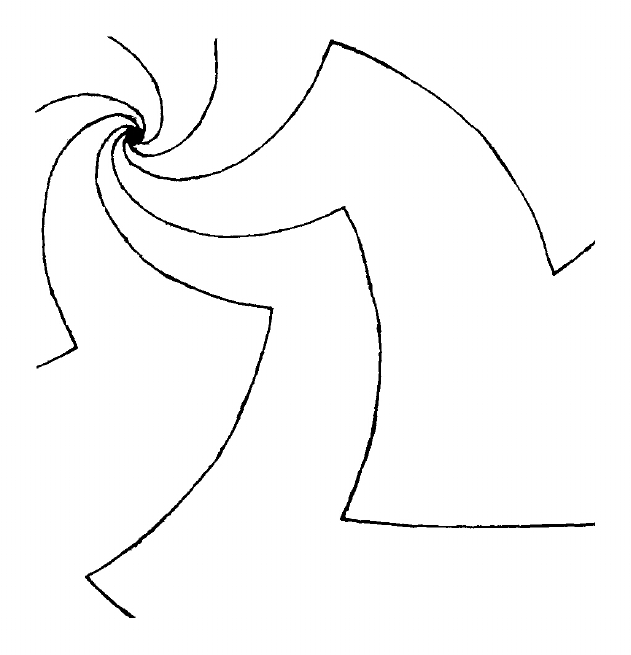
Actually, from our perspective the electron appears to have instantaneous reversals of direction because it happens in approximately 4x10 -22 second. This is a fraction of a second that, when written, looks like this:
4/10,000,000,000,000,000,000,000 second.
The reversal time is apparently the same for all natural frequencies of electromagnetic radiation. It is the time of each rotation (turn-around).
It takes time for the electron to pass a point in its travel and return to pass the same point, and in this time the nether continues to move inward without alteration either radially or tangentially relative to the vortex itself.
The electron accelerates each time in moves from its end point of travel to its midpoint of travel, and decelerates each time it moves from its midpoint of travel to its end point. During this period, the radial inward flow vector and the tangential flow vector remain essentially constant relative to an observer. Very near each end point of travel, when rotating during its turn, the vortex changes its polar direction relative to an observer (like a whirlpool that is right side up turning upside down.) This causes the tangential vector of the inflow to change direction 180 degrees.
So the actual average nether flow of the vibrating electron is similar to a sine wave as shown on the preceding page.